

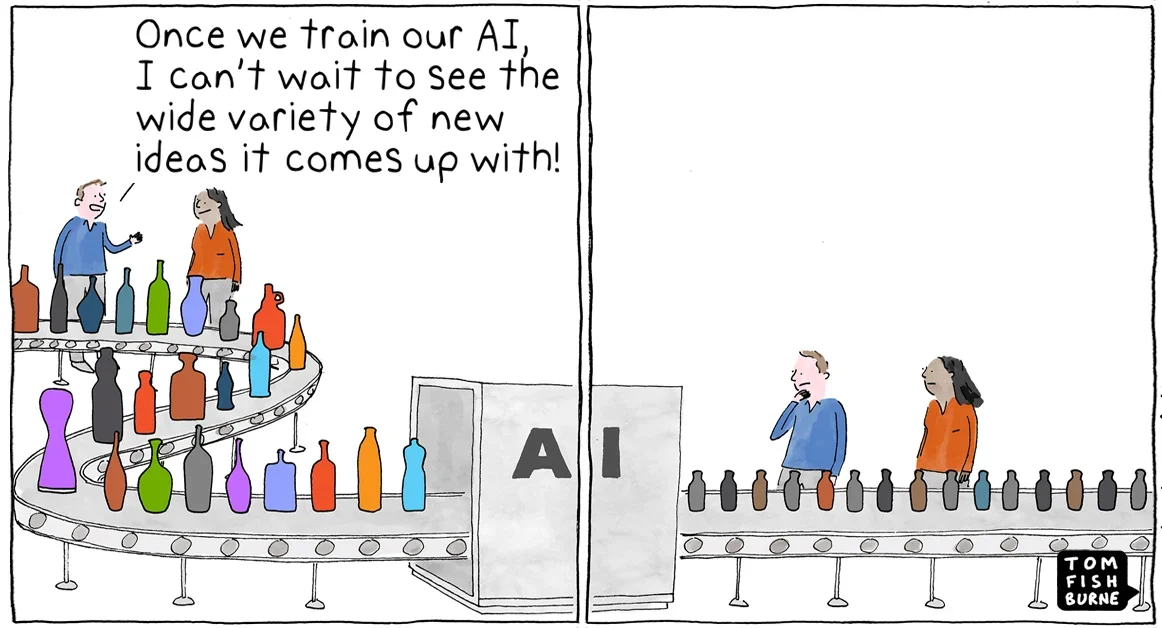

AI adoption is rising, but adoption data cannot tell a buyer whether one AI company is meaningfully different from another. at the same time, AI products are becoming more specialised while the market-facing language around them keeps converging around intelligence, automation, trust and transformation. the result is a recognition problem: real technical difference can exist while the buyer meets almost identical signals before the demo.
adoption and differentiation are different questions
iRO’s recent Ireland and UK coverage shows AI moving from experimentation toward broader business use. that is useful context, but adoption tells us how widely the category is used, not whether individual products are easy to compare or remember.
where technical difference gets lost
the signal can weaken as it moves from engineering to product, sales and marketing. each function simplifies for a valid reason, but the chain can end with generic category language that removes the consequence of the original technical difference.
the substitution test
if a competitor name can replace yours across the headline, first proof points and hero visual without anything feeling wrong, the company is probably communicating the category more clearly than the product.
capability -> consequence -> proof
for each important differentiator, separate what the product can do, what changes for the buyer because it can do it, and what evidence makes that claim believable. marketing should not replace technical proof. it should make the proof easier to find and understand.
category shorthand helps until it becomes camouflage
familiar signals reduce cognitive load, which is useful. the problem begins when the same AI vocabulary and visual language carries more of the story than the product-specific difference.
what the buyer should be able to verify next
a strong market signal should lead to a better next question: a benchmark, architecture note, named use case, implementation constraint, certification or other evidence appropriate to the claim.
public sources / research
Central Statistics Office, Information Society Statistics – Enterprises 2025, for Irish enterprise AI adoption context.
PwC, 2026 AI Jobs Barometer, for AI-related labour-market context.
iRO’s recent AI adoption articles for publication-specific framing and evidence discipline.
first-hand branding experience
i work directly on positioning and identity systems for B2B and technology companies through Vizura Studio® in Zagreb. the recurring pattern i can credibly contribute is not whether an AI architecture is technically superior. it is what happens between real capability and market comprehension: which difference is made visible, which claims point to proof, and whether the verbal and visual system makes the company easier to evaluate before deeper technical due diligence.
editor reference / author information
Vedran Obradović | founder and designer, Vizura Studio® | Zagreb, Croatia | independent one-man branding studio | 8+ years in branding and identity
focus: B2B and technology branding, including SaaS, AI, cybersecurity, consulting and finance
short bio: Vedran Obradović is the founder and designer behind Vizura Studio®, an independent branding studio in Zagreb focused on B2B and technology companies. his work spans positioning, brand strategy, visual identity and digital experience.
studio: https://www.vizurastudio.hr/ | portfolio: https://www.vizurastudio.hr/work | about: https://www.vizurastudio.hr/about
personal site: https://www.vedranobradovic.com/ | LinkedIn: https://www.linkedin.com/in/vedranobradovic/
email: vedran@vizurastudio.hr | phone: +385 91 594 3264 | WhatsApp: https://wa.link/9apup7 | book a call: https://cal.com/vizurastudio
public project: Breach https://www.vizurastudio.hr/hr/work/breach-b2b | credentials: HDD professional member since 2026; Upwork™ recognition 2024/2026; Adobe professional logo-design training.
FAQs
1. What is AI adoption in the UK?
Answer:
AI adoption in the UK refers to businesses using artificial intelligence technologies in their operations, products or services. ONS data shows that self-reported AI use among UK businesses with 10 or more employees increased from around 12% in late 2023 to around 35% in 2026. Adoption varies significantly by industry and business size.
2. Is AI adoption increasing among UK businesses?
Answer:
Yes. ONS analysis shows that the proportion of UK businesses with 10 or more employees reporting AI use has increased substantially since late 2023. However, ONS also describes adoption as relatively shallow, meaning adoption rates alone do not necessarily indicate deep or complex AI integration.
3. Which UK industries are adopting AI most?
Answer:
AI adoption varies by industry. The latest ONS analysis reports particularly high reported use in information and communication, at 58%, while construction was much lower at 13%. This demonstrates that UK AI adoption is uneven across sectors.
4. Why does rising AI adoption make differentiation more difficult?
Answer:
As more companies enter the AI market, they often use similar language to explain their products, including terms such as intelligence, automation, transformation and trust. This can make genuinely different technologies appear similar to buyers before they examine technical documentation, use cases or other evidence.
5. How can buyers tell whether an AI company is genuinely different?
Answer:
Buyers can separate genuine differentiation from generic positioning by examining what a product can do, what changes for the customer and what evidence supports the claim. Useful evidence can include benchmarks, architecture information, named use cases, implementation requirements, certifications and measurable results.
6. What is the substitution test for AI companies?
Answer:
The substitution test asks whether a competitor’s name could replace a company’s name across its headline, first proof points and main visual without making the communication feel incorrect. If it can, the company may be communicating the AI category more strongly than its own product-specific difference.
7. What is capability-consequence-proof in AI marketing?
Answer:
Capability-consequence-proof is a way of explaining an AI product by separating what it can do, what changes for the buyer because of that capability, and what evidence makes the claim credible. It helps connect technical differentiation with a clearer buyer decision.
8. Why can AI marketing language make products look similar?
Answer:
AI marketing language often relies on familiar category terms because they reduce the cognitive effort required to understand a new technology. The problem occurs when common terminology becomes more prominent than the specific capability, customer consequence or evidence that differentiates a product.
9. What evidence should buyers request from an AI company?
Answer:
The appropriate evidence depends on the claim being made. Buyers may need benchmarks, architecture documentation, security information, certifications, named use cases, implementation constraints, integration details or measurable customer outcomes. A strong market signal should lead to a more specific question that can be independently examined.
10. Is AI adoption the same as AI integration?
Answer:
No. Adoption means that a business reports using AI, while integration concerns how deeply AI is incorporated into business processes, products or decision-making. ONS data indicates that UK adoption has increased while the average number of AI technologies used by adopting businesses has risen only modestly.
11. Why does AI differentiation matter to UK businesses?
Answer:
As more UK businesses encounter AI providers and solutions, buyers need to distinguish between products based on relevant capabilities, consequences and evidence rather than category language alone. Clear differentiation can make technical due diligence easier because the buyer knows which claims and evidence to investigate.
12. What is changing in the UK AI market?
Answer:
The UK AI market is moving towards broader business adoption while demand for AI skills is also increasing. PwC reported a 61% year-on-year increase in specialist AI job postings in the UK in its 2026 AI Jobs Barometer.
