

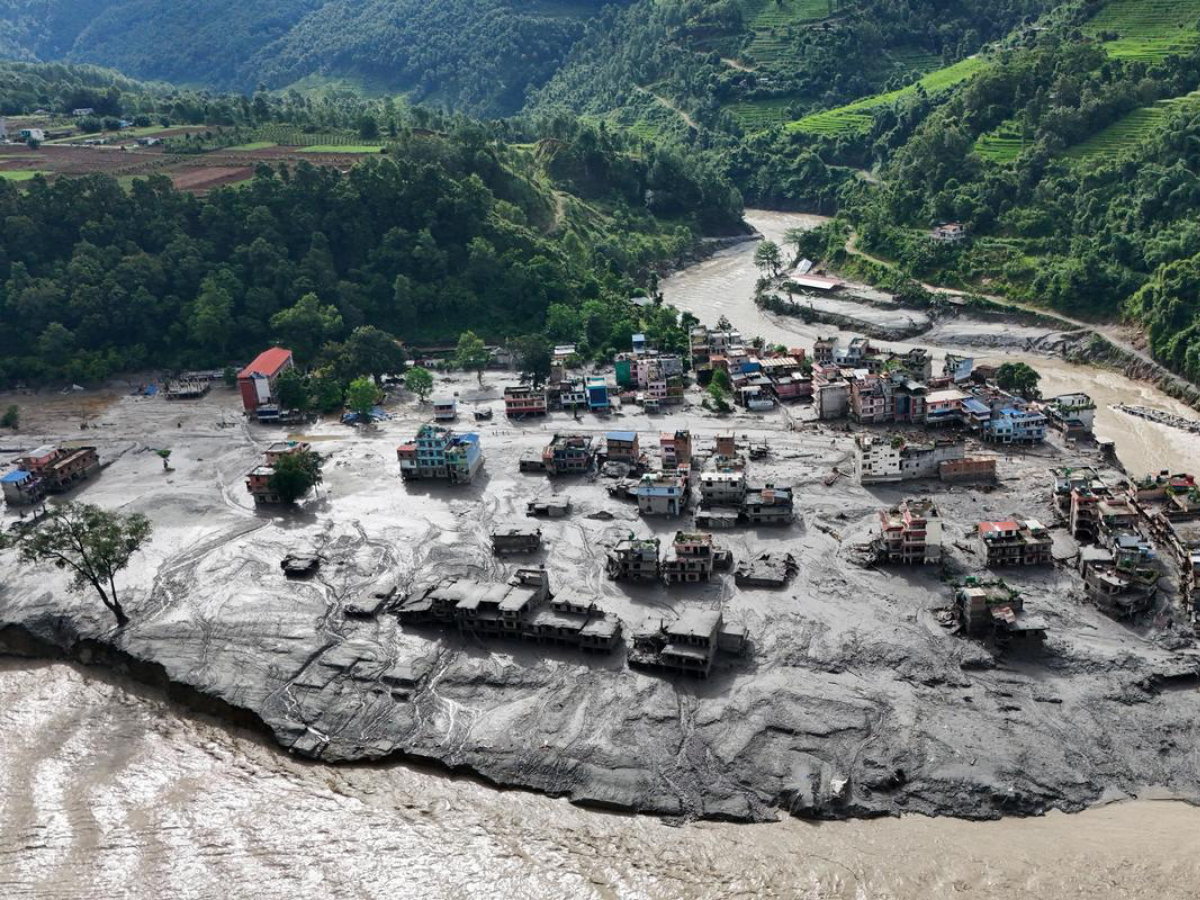

Nepal is facing a catastrophic flood emergency after a sudden flash flood struck the Bhote Koshi River area on 26 August, killing hundreds of people, destroying infrastructure and leaving large numbers of people missing.
The disaster has also become an international humanitarian story. Nepal has said it does not currently require foreign search-and-rescue teams, despite offers from several countries, including Sri Lanka, Britain, India, China, Japan, South Korea, the United States and Bangladesh.
Sri Lanka has now pledged US$1 million in financial assistance for relief efforts in Nepal.
For readers in Britain and Ireland, the disaster has an additional significance: Nepal’s official missing-person information published on 27 August included 33 UK nationals and two Irish nationals.
Key Facts
| Development | Latest information |
|---|---|
| Disaster | Severe flash flooding in the Bhote Koshi River area |
| Date | 26 August 2026 |
| Main affected area | Rasuwa and downstream districts |
| Latest reported death toll | 489 in Nepal, according to Reuters’ 28 August report |
| Additional deaths | Five reported in Tibet |
| Foreign nationals missing in Nepal | 596 in Nepal’s 27 August official update |
| UK nationals listed missing | 33 |
| Irish nationals listed missing | 2 |
| Sri Lankan assistance | US$1 million financial pledge |
| Foreign rescue teams | Nepal says they are not currently required |
| New danger | Landslide-created lake overflowed on 28 August |
The figures are changing as search and rescue operations continue. Nepal’s own 27 August update recorded 359 bodies recovered and 596 foreign nationals still missing, while Reuters reported a substantially higher death toll on 28 August. The figures should therefore be treated as a developing situation rather than a final casualty count.
What Happened in Nepal?
The disaster began on 26 August in the Bhote Koshi River area of Rasuwa district, close to Nepal’s border with China.
The flooding caused extensive destruction to homes, roads, bridges, hydropower facilities and other infrastructure. Nepal’s Ministry of Foreign Affairs said national security and disaster-management agencies had been mobilised for search, rescue, evacuation, medical assistance and relief operations.
The damage has made the rescue operation particularly difficult.
The affected route is also important because it connects Kathmandu with Tibet and is used by trekkers and pilgrims travelling towards the Himalayan region.
Reuters reported that the initial disaster followed a glacier collapse that sent rock, ice, mud and debris through Himalayan river systems.
How Many People Have Died in the Nepal Flood?
The casualty figures have continued to rise as rescuers search damaged communities and river valleys.
Reuters reported on 28 August that 489 people had been killed in Nepal, with another five deaths reported in Tibet.
Nepal’s Foreign Ministry had reported 359 recovered bodies in its 27 August update, alongside 596 foreign nationals still missing.
The difference between the two figures illustrates how rapidly the situation has been changing.
Search operations are continuing and casualty figures may change again as authorities recover people from affected areas and verify missing-person reports.
A New Flood Threat Emerged on Friday
The disaster became even more dangerous on 28 August when a lake created by a landslide on the Nepal-China border began overflowing.
Reuters reported that the lake had accumulated more than 2.5 million cubic metres of water before it overflowed into the Bhote Koshi River.
The development briefly forced rescue workers to move to safer locations.
Nepal halted rescue operations for about 90 minutes before restarting them after officials assessed the immediate risk.
The new threat matters because communities already affected by the original flash flood faced the possibility of another surge of water.
Did Nepal Reject Foreign Rescue Teams?
Yes, but the wording is important.
Nepal has said it does not currently require foreign search-and-rescue assistance.
Nepal’s Foreign Ministry said its own security agencies were conducting search-and-rescue operations and that, for now, additional foreign rescue teams were not required.
Reuters reported that India, China, the United States, Britain, Japan, South Korea, Sri Lanka and Bangladesh had asked Nepal about allowing their search-and-rescue teams to assist.
Nepal’s position does not mean that the country has rejected all international support.
The Nepalese government has appealed for financial assistance and is continuing to assess what help is required for relief, rehabilitation and recovery.
Did Sri Lanka Help Nepal?
Yes.
Sri Lanka has provided diplomatic support and offered assistance following the disaster.
The latest confirmed development came on 28 August, when Sri Lanka announced a US$1 million financial assistance package for people affected by the floods and landslides in Nepal.
Sri Lankan President Anura Kumara Dissanayake instructed the government to provide the funds, while Foreign Minister Vijitha Herath spoke with Nepal’s Foreign Minister Shishir Khanal.
Sri Lanka was also among the countries that offered potential search-and-rescue assistance.
However, because Nepal has said it does not currently require foreign search-and-rescue teams, the confirmed Sri Lankan contribution is the US$1 million financial pledge, rather than the deployment of a Sri Lankan rescue team.
That distinction is important.
Why Is Sri Lanka’s Assistance Significant?
Sri Lanka is a relatively small country compared with some of the major powers offering assistance to Nepal, but its response demonstrates that international disaster assistance is not limited to the world’s largest economies.
Sri Lanka and Nepal have longstanding diplomatic ties, and Sri Lankan officials have expressed solidarity with the Nepalese people following the disaster.
The US$1 million pledge is intended to support relief efforts, while Sri Lanka has also said it will work with Nepal to explore further ways of supporting relief and recovery.
Are British Nationals Missing in Nepal?
Yes.
Nepal’s Ministry of Foreign Affairs reported 33 UK nationals among those still missing in its 27 August list of foreign nationals affected by the disaster.
The UK Government has issued updated travel advice warning that the flooding caused widespread damage to buildings, roads, transport and communications infrastructure.
It also warns that further flooding is possible and advises people in affected areas to follow instructions from Nepalese authorities.
The British Government has said it is supporting British nationals affected by the disaster and remains in contact with relevant authorities.
Are Irish Nationals Missing in Nepal?
Yes.
Nepal’s official 27 August list recorded two Irish nationals as still missing.
Ireland’s Department of Foreign Affairs has issued a specific travel alert covering the Rasuwa district and Nepal-China border areas.
It says the flooding caused widespread damage to buildings, roads, transport and communications infrastructure and that downstream areas including Nuwakot, Dhading and Chitwan have also been affected.
Irish citizens affected by the flooding are advised to contact Ireland’s consular authorities for assistance.
What Does the Nepal Flood Mean for Travellers?
The immediate message for travellers is caution.
The UK Government has warned that the situation may change rapidly and that people travelling in affected areas should follow local authorities and remain alert to further flooding.
Ireland’s Department of Foreign Affairs has similarly advised travellers to monitor local conditions and transport arrangements.
The damage to roads, bridges and communications infrastructure means that journeys which might normally be straightforward can become difficult or impossible.
Anyone currently in Nepal should therefore rely on official travel and emergency information rather than attempting to reach affected areas independently.
What Areas of Nepal Have Been Affected?
Rasuwa is at the centre of the disaster, but the consequences extend downstream.
Nepal’s Foreign Ministry identified affected riverside areas including:
- Rasuwa
- Nuwakot
- Dhading
- Gorkha
- other downstream areas
Ireland’s Department of Foreign Affairs has specifically highlighted Rasuwa, Nuwakot, Dhading and Chitwan in its travel warning.
The destruction of roads, bridges and communications infrastructure is likely to complicate both rescue operations and movement through affected areas.
Why Is the Rescue Operation So Difficult?
The geography is one of the major challenges.
The disaster occurred in a mountainous Himalayan environment where rivers run through narrow valleys and transport infrastructure is vulnerable to flooding, landslides and debris.
The initial flood damaged roads and bridges, while the subsequent threat from a landslide-created lake introduced another layer of danger.
Rescuers must therefore balance the need to find missing people with the risk of exposing rescue teams to additional flooding.
The number of foreign nationals involved also makes the operation a major consular challenge for governments around the world.
What Happens Next?
The immediate priority is to locate missing people, rescue survivors and move communities away from further flood danger.
Nepal’s authorities are continuing search-and-rescue operations through national security and disaster-management agencies.
The government is also seeking financial support for relief and recovery.
Meanwhile, other countries are monitoring the situation and supporting their own nationals.
For Sri Lanka, the next confirmed step is implementation of its US$1 million financial assistance pledge and discussions with Nepal about further support.
For Britain and Ireland, consular authorities will continue working to establish the whereabouts of their nationals affected by the disaster.
The situation remains fluid, particularly because of the continuing risk from unstable terrain and water levels.
The Bigger Question: What Does the Disaster Show?
The Nepal floods highlight the extraordinary vulnerability of communities living in high-altitude river systems.
A disaster can move rapidly from a localised mountain event into an international humanitarian emergency when roads, hydropower infrastructure, border routes and tourist corridors are affected.
The large number of foreign nationals reported missing also shows how interconnected Himalayan tourism, pilgrimage, trade and regional travel have become.
For Ireland and the UK, the immediate concern is the safety of their citizens.
For Nepal, the longer-term challenge will be rebuilding damaged infrastructure and supporting communities whose homes and livelihoods have been affected.
And for neighbouring and partner countries such as Sri Lanka, the disaster is creating a wider question about how international assistance can be delivered when a country chooses to manage search and rescue primarily through its own agencies.
Nepal Flood Latest: What Readers Need to Know
The most important points are straightforward.
Nepal was hit by a devastating flash flood on 26 August.
Hundreds of people have died and many remain missing.
A second flood risk emerged on 28 August after a landslide-created lake overflowed.
Nepal says it currently does not require foreign search-and-rescue teams.
Sri Lanka has pledged US$1 million in financial assistance.
The official 27 August missing-person list included 33 UK nationals and two Irish nationals.
Both the UK and Ireland have issued travel warnings concerning the affected region.
The rescue operation is continuing and the casualty figures remain subject to change.
TAKEAWAYS
Key facts
- Flash flooding struck Nepal on 26 August 2026.
- The Bhote Koshi River and Rasuwa district were central to the disaster.
- Reuters reported 489 deaths in Nepal on 28 August.
- Five additional deaths were reported in Tibet.
- Nepal reported 596 foreign nationals missing in its 27 August update.
- 33 UK nationals were listed as missing.
- Two Irish nationals were listed as missing.
- Sri Lanka offered assistance and was among countries asking about rescue-team deployment.
- Nepal said it did not currently need foreign search-and-rescue teams.
- Sri Lanka pledged US$1 million in financial assistance.
- A landslide-created lake containing more than 2.5 million cubic metres of water overflowed on 28 August.
- UK and Irish authorities have issued travel warnings.
FAQ SECTION
1. What happened in Nepal?
A catastrophic flash flood struck the Bhote Koshi River area of Nepal on 26 August 2026, causing widespread deaths, destruction and displacement.
2. How many people died in the Nepal floods?
Reuters reported 489 deaths in Nepal and five deaths in Tibet on 28 August. The casualty figure remains subject to change as rescue operations continue.
3. Did Sri Lanka help Nepal?
Yes. Sri Lanka pledged US$1 million in financial assistance for flood and landslide relief in Nepal on 28 August.
4. Did Sri Lanka send rescue teams to Nepal?
Sri Lanka was among countries that offered potential search-and-rescue assistance, but Nepal said it did not currently require foreign rescue teams. The confirmed Sri Lankan assistance announced on 28 August is a US$1 million financial pledge.
5. Why did Nepal reject foreign rescue teams?
Nepal’s Foreign Ministry said its own security agencies were conducting search and rescue and that foreign teams were not currently required.
6. Are British people missing in Nepal?
Yes. Nepal’s 27 August official list recorded 33 UK nationals as still missing.
7. Are Irish people missing in Nepal?
Yes. Two Irish nationals were listed as still missing in Nepal’s 27 August official update.
8. Is Nepal safe to visit after the floods?
The affected region is experiencing severe disruption and further flood risk. UK and Irish authorities advise travellers to follow local instructions and monitor conditions closely.
9. What caused the Nepal flash flood?
Reuters reported that the disaster followed a glacier collapse that sent rock, ice, mud and debris through Himalayan river systems.
10. Is the Nepal flood situation over?
No. Rescue operations are continuing, and a landslide-created lake overflowed on 28 August, creating an additional flood risk.
